Monday, September 22, 2008

Advantages, Details, and Disadvantages of 403b Plans

www.erollover.com/


Advantages, Details, and Disadvantages of 403b Plans

403b plans are retirement savings plans that allow you to make annual dollar contributions (just like 401k plans) and let them grow tax-deferred up until you withdraw them (upon retirement). Note the fact that 403b plans allow for pre-tax contributions (that is from your Gross Wage). Go here to read about the distinctions between pre-tax and after-tax 401k contributions. 403b plans are also known as tax-deferred annuities.

403b Plans are engineered for employees of tax-exempt organizations such as:
- Churches
- High schools, colleges & universities
- Museums
- Hospitals
- Other social & public welfare charities


Since your contributions towards a 403b plan come out of your GROSS WAGE, this means you will be lowering your current taxable income by the amount of the contribution. This means you will be paying lower taxes NOW!

Advantages of 403b Plans

- As mentioned above, your lower your current taxable income by contributing towards a 403b plan. This also allows your contributions to grow tax-deferred up until withdrawal. All the years of compounding interest will surely add up!
- When you retire, chances are higher that you will be in a lower tax bracket (because you will have quit your job). Therefore, apart from lowering your current taxable income, you also lower the taxes you will pay upon retirement (and maturity of your 403b plan).
- The 403b contributions are automatically deducted from your paycheck, therefore you have no worries about the administration of your contributions.
- 403b plans allow you to choose where your money is invested in. Go here to read more about 401k and 403b investment options.

403b Plan Contributions

The maximum pre-tax 403b contributions that you are allowed to make is $15000 in 2006.

Year Max 403b Contributions
2004 $13000
2005 $14000
2006 $15000

This maximum amount will increase by $500 every year after the year 2006.


403b Catch Up Contributions

For 403b contributors over the age of 50, additional “catch up” contributions of $5000 in the year 2006 are available. After the year 2006, this amount can be increased by $500 a year. Therefore:

Year 403b Catch Up Contributions

2005 $4000
2006 $5000
2007 $5500
2008 $6000
2009 $6500

Furthermore, certain special employees who have served in any type of organization (listed above) for more than 15 years or more are allowed to make an extra pre-tax contribution of $3000 per year towards their 403b plans.

Where the 403(b) Can Be Invested

403(b) money can be invested in a fixed annuity; and/or variable annuity; and/or a mutual fund.

Fixed Annuities

Fixed annuities operate much like certificates of deposit but are not insured by the Federal Deposit Insurance Company (FDIC). Generally, investors are given two interest rates: the current rate and the guaranteed rate. The current rate is the return that the insurance company promises to pay for a set period of time, typically between one and five years. The guaranteed rate, usually lower, is the minimum rate that investors will receive after the current rate expires, regardless of market conditions.

Variable Annuities

A variable annuity offers a range of investment options — typically mutual funds that invest in stocks, bonds, short-term money-market instruments, or some combination of the three. These investments options are referred to as the subaccount. The value of the investment will vary depending on the performance of the investments in the subaccount. There is usually a death benefit that will pay a beneficiary the greater of the account value or a guaranteed minimum amount, such as total purchase payments. Variable annuities are securities regulated by the Securities and Exchange Commission (SEC).


Mutual Funds


A mutual fund is an investment that pools money from many participants and invests in stocks, bonds, short-term money-market instruments, or some combination of the three. The combined holdings of stocks, bonds, or other assets that the fund owns are known as its portfolio. Each investor in the fund owns shares, which represent a part of these holdings. There are two kinds of mutual funds: loaded mutual funds and no-load mutual funds. A load is a commission the investor must pay in order to purchase/sell that fund. All mutual funds have operating costs. Mutual funds are securities regulated by the SEC but are not guaranteed or insured by the FDIC or any other government agency.

Please visit our site for more Retirement, 401k, and Insurance details:
www.erollover.com

Saturday, September 13, 2008

Watch out for these Retirement Scams!

www.erollover.com/

Subscribe in a reader

ShareThis

Subscribe to erollover.com Blog by Email


Watch out for these Retirement Scams!

By: Joshua Lipton, Forbes Magazine

After reading about it in the local newspaper, you decide to attend a seminar at a neighborhood steakhouse where a broker will offer a lecture on how to retire early, earn high investment returns and enjoy steady annual cash withdrawals, all while you finish off that complimentary, medium-rare T-bone.

The broker is dressed sharp while pitching his difficult-to-resist game plan. The catch of course is that you will have to roll over your 401(k) plan and open an individual retirement account at his firm. There is brief mention of risk associated with stock market volatility and of fees, but you focus on the promise of capital growth and juicy annual withdrawals of 9%. Sounds too good to be true. And it is.

According to securities regulators, these types of luncheon pitches are rampant across America. But they warn that, in most cases, the safe and secure annual withdrawal amounts too often assume stock market returns that aren't realistic. As a result, many investors find that in the end their nest egg has been fried. Instead of pursuing leisurely passions, these "free lunches" wind up leaving would-be retiree's scanning the local newspaper for job listings.

Get Equifax Credit Watch Gold 3-in-1 Now!

The oldest baby boomers turn 62 this year, and more than 70 million of them will likely enter retirement over the next 20 years, says T. Rowe Price. Retirement assets in the U.S. topped $17.6 trillion in 2007, up 7% from 2006, according to the Investment Company Institute. But the current retiring crop of boomers is faced with the misfortune of ending their income accumulation years during a bear market. Moreover, after a "lost decade", when the S&P 500 barely advanced, many feel like they need to make up for lost capital fast. That fear, coupled with a general lack of financial education, makes them easy targets for hustlers looking to make a quick buck.

These days, retirement scams range from the out and out fraud, where scammers intentionally separate seniors from their capital, to the more benign cases such as employers misusing or squandering the assets in a 401(k) plan.
"It is a concern", says Fred Joseph, the Colorado Securities Commissioner. "Some investment promoters tell people they can retire and make more money than they did when they were working. So they encourage people to take money out of the company pension plan or the 401(k) and give it to them."

Adds Joseph, "If they are legitimate, they will put it in an annuity, for example, that has high costs, high surrender charges and high up-front fees. That's if they are legitimate. If they are not legitimate, they will just spend your money. Then you're broke."


Although individuals aged 60 or older make up just 15% of the U.S. population, they account for 30% of fraud victims, according to the North American Securities Administration Association. The oldest ripoffs still remain the most popular, regulators say: Ponzi and pyramid schemes, pump and dumps, and high-return or "risk free" investments. Other common cons include "prime bank" fraud.
This is a scheme in which a "prime bank note" is supposedly issued or traded by some of the world's biggest banks. Joseph explains how they work: The transactions involve notes, guarantees, letters of credit, debentures or other seemingly legitimate types of financial instruments being issued by an unidentified "prime" bank. Of course, it's all a fairy tale: Neither the prime bank note nor the secret bank trading program exists.

Get The Wall Street Journal for 75% off!

Joseph says these schemes have been around since the 1980s, but investors still manage to get taken by the scams, year in and year out.

Last year the U.S. Attorney's office, the FBI, IRS and the Colorado Securities commission convicted a Denver-based high-yield/prime bank investment scheme of mail fraud, wire fraud, securities fraud and money laundering. The too-good-to-be-true investments were sold using names like "Capital Holdings", "Reserve Foundation Trust" and "Fast Track". And, in the end, hundreds of investors were defrauded of more than $50 million. Between 1999 and 2003, Norman Schmidt of Denver, the scheme's leader, his wife Jannice, along with five other co-conspirators promised prospective investors rates of return from 2% to 400% per month.

Impressive-looking monthly statements were sent out like clockwork and investors were encouraged to let their profits ride and invite friends into the deal. Investors were also assured that a prominent insurance company would cover them from losses. In the meantime, the funds held in more than 60 bank accounts, were used in part to support the promoter's lavish lifestyle, including the purchase of eight NASCAR race cars, and Aspen's Redstone Castle, an Italianesque mansion built in 1901 that spans 20,000 square feet and has 42 rooms and 11 bathrooms.

But prime bank scams are yesterday's news. The new game plays off skyrocketing oil prices and $4 per gallon gas. According to Joseph, oil and gas scams have become the "fraud de jour". He is currently dealing with about 24 such fraud cases in Colorado. "It's one of my biggest issues right now", he says.

Last spring, for example, Joseph's office settled an enforcement action against a Wichita, Kan., operation going by the name of Key Resource Companies along with its president, Dale Lucas and vice presidents Russell Kilgariff and Michael McNaul. Oil and gas wells gushing profits was the lure and the investments were peddled between 2003 and 2006.


What the promoters failed to tell the suckers, say regulators, was that they were paying these sales agents up to 50% of the invested amount in commissions and that at least one of their agents was a convicted felon. In the end, the defendants had to pay $300,000 in restitution to 15 Colorado investors, and were barred permanently from the security industry in Colorado. Investors, of course, lost most of their money.

Get The Wall Street Journal for 75% off!

According to regulators, there are a number of ways investors can protect themselves against retirement scams.
First, remember these four basic red flags, says the U.S. Securities and Exchange Commission: If it sounds too good to be true, it is; guaranteed returns aren't; beauty isn't everything (a fancy looking Web site doesn't mean the party behind the site is credible); pressure to send money right away. If you spot any one of these themes in the sales pitch, the SEC says, be skeptical about the legitimacy of the investment.

Equally important: Know the salesperson. The Financial Industry Regulatory Authority is the largest non-governmental regulator for all securities firms doing business in the United States. You can verify registration and disciplinary information about an individual broker or brokerage firm by using FINRA BrokerCheck or calling them toll-free at 800-289-9999. If that broker is registered, check to see if there is any kind of employment or disciplinary history.

To double-check the background of an investment adviser, contact your state securities regulator or call 202-737-0900.
Another common sense tip: Before committing to any kind of retirement strategy, FINRA recommends consulting with a financial professional of your choosing instead of immediately signing on with someone who "found you".

"Make sure that you don't isolate yourself from people that you would usually get advice from, like your attorney or accountant", says John Gannon, FINRA's Senior Vice President for Investor Education. "The person who is going to commit fraud is usually someone you just met, who persuades you to do something that, if you thought logically about it, you probably wouldn't do. It is very important to get a second opinion".

Another smart move: Cut back on unsolicited phone calls. Put your name on the national Do Not Call Registry: 1-888-382-1222. "I consider the phone to be a weapon", says Joseph. "It can be used just like a gun to steal money".
Finally, be cautious about those ever-popular "free lunch" seminars, where finance "experts" arrive, dish out free eats and tout schemes promising early retirement with no deduction in income.

Regulators conducted 110 examinations between April 2006 and June 2007 of these seminars. The result: 57% of the firms used advertising and sales materials that were misleading, exaggerated or included unwarranted claims. Joseph offers this guidance: "My own advice is to be skeptical. The motive for these guys, remember, is to sell you something".

Please visit our site for more Retirement, 401k, and Insurance details:
www.erollover.com

Related: retirement scams, retirement, personal finance, ira rules, ira rollover, ira, investments, investing, asset allocation, 401k-scams, 401k

Tuesday, September 9, 2008

Don’t put your retirement plan totally on automatic

Subscribe to erollover.com Blog by Email

by The Associated Press www.Erollover.com 2008

Don’t put your retirement plan totally on automatic

September 9, 2008

Just because something’s automatic doesn’t mean you can totally sit back and relax; especially when it comes to your retirement. In recent years more companies have been shifting away from traditional pensions and placing the responsibility for retirement planning more squarely on individuals. As part of the move, many employers now offer automatic enrollment in their 401(k) programs and are changing the types of funds they offer. While these enhancements may be to your benefit, you’ll still want to ask some important questions.

Following are answers to questions about how those changes could affect 401(k) programs.

My company has an automatic-enrollment 401(k) program that increases contributions over time and takes care of how the money is invested. Am I safe to just leave decisions to the plan administrators or shall I still be involved?

Auto-enrollment programs have grown rapidly since the Pension Protection Act was signed into law two years ago. It has increased the number of workers setting aside money for retirement because it’s easy. However, you should monitor your account and may need to make adjustments to suit your individual situation. “Most of the automatic decisions are good for employees, but employees still need to stay engaged in the retirement planning process, making sure that the decisions being made for them are in line with their retirement goals,” said Christopher Jones, chief investment officer of Financial Engines, a Palo Alto, Calif., investment advisory and management company.

Are target-date or life-cycle funds a good idea? Some say they can become too conservative too soon, reducing potential earnings.

Target-date funds are an increasingly popular option in many employer retirement plans. The Investment Company Institute says target-date funds grew from about $2 billion in assets in 1997 to $183 billion in 2007. Roughly 5 percent of the assets held in employer-sponsored retirement plans are invested in target-date funds. These funds allow an employee to choose a retirement date - 2030, for example - and invest assets accordingly. Typically, the funds invest aggressively early on, aiming to earn higher returns, then become increasingly conservative, placing more of the money in safer investments - usually bonds - carrying less risk and usually lower returns.

Should I be worried if my 401(k) administrator is replacing mutual funds with collective investment funds?

Collective funds are similar to mutual funds in that they pool investors’ money and invest in stocks, bonds and other securities. The biggest difference is that they are typically available only in retirement plans and are not regulated by the Securities and Exchange Commission. Instead, they are under the jurisdiction of bank regulators and the Department of Labor. Because collective investment funds don’t have some of the regulatory requirements of mutual funds, they are less expensive than certain types of mutual funds. Thus, they may be offered through a 401(k) plan at a lower cost to participants, said advisers at The Vanguard Group.

Please visit our site for more Retirement, 401k, and Insurance details:
www.erollover.com

Monday, September 8, 2008

8 money moves you must make at 50

www.erollover.com/

Subscribe in a reader

ShareThis

Subscribe to erollover.com Blog by Email

by Mike Rowan www.Erollover.com 2008

8 money moves you must make at 50

Face it, you're getting older, so now is the time to make preparations for health changes and retirement.
If you're turning the corner into your sixth decade, you've probably heard the jokes about getting older. The ones that start, "You know you're 50 when":

  • The elevator is playing your favorite song.
  • Dinner and a movie are the whole date, not just the warm-up.
  • You look like the morning after and you haven't been anywhere.
  • You throw a party and the neighbors don't call the cops. In fact, they don't even realize you had a party.

All the aches, pains and startling glimpses of that stranger in the mirror drive home the point: You're not going to live forever, and it's time to get serious about your future, financial and otherwise.

The good news, for most 50-somethings, is that they're in their peak earning years. Many (but not all) are done with child-rearing, which leaves more money in the kitty for other goals, like retirement. Most are homeowners, and past boom years have added nicely to the typical 50-something's net worth.

FINANCIAL SNAPSHOT: AGES 50-59

Median household income $60,586
Median net worth $182,300
Percent with home equity 80.70%
Percent with credit card debt 50.30%
Median amount owed on cards $2,700
Percent with traditional pensions 38.10%
Percent with minor children 40.30%

Source: Federal Reserve Survey of Consumer Finances, 2004

But dangers abound. Inadequate savings or high debt levels can cripple retirement plans, as can illness, disability or layoffs. Poor planning, insufficient insurance protection and boomerang kids (adult children who return to live at home) pose additional risks. And by making some crucial decisions now, about timing your retirement or where you might live, you'll be better able to map out your plans.

If you want to get yourself in the best financial shape possible at this milestone, take the following steps:

Reconsider your career
Most baby boomers say they want to work at least part time in retirement. Work can have social, emotional and, especially, economic benefits: The longer you're employed, the less you need to save for retirement.
But what if you hate your job or your industry is downsizing rapidly? (Think airlines, newspapers and U.S. auto manufacturing.) You can wait to get fired, or you can figure out what you'd really like to do when you grow up, and see if you can get there from here. A session with a career counselor could help; so could that venerable career changer's guide


Beware the temptation to pitch it all and go back to school for years on borrowed money, however. You're unlikely to recoup the investment, and you could end up saddled with student loans in your 80s. If you need additional training, night school is usually the better bet. If you're dying to start your own business, do it as a sideline first to see if you can make your idea fly.

Put retirement on the front burner
Sure, you've got other obligations. You may still have kids to raise and educate (two out of five 50-something households include minor children), and your folks may need financial help as well.

But saving for your retirement still needs to be your top priority. You're also close enough to the finish line now, the median retirement age these days is 62, that you should begin to make definite plans about where you'll live, what you'll do and how much money you'll spend. If you don't have a specific age or date in mind, try several scenarios using eRollover's Retirement Planner. eRollover's Retirement Expense Calculator can help you nail down the changes you can expect in your spending.

If you're thinking about retiring before age 65, when Medicare coverage kicks in, consider your health insurance options:

  • Does your company offer retiree medical coverage? Most don't, and many of those that do are phasing out coverage.
  • Could you be covered under a spouse's workplace plan?
  • Would you be eligible for COBRA and/or HIPPAA continuation coverage?

Under the 1986 Consolidated Omnibus Budget Reconciliation Act (COBRA), you can continue your employer's health insurance coverage for up to 18 months after you retire, as long as your employer offers health insurance and employs more than 20 people. You'll pay for the privilege: You must take over the whole premium (the portion you've been paying plus what your employer pays) and an additional 2% administrative charge.

After the 18 months is up, the 1996 Health Insurance Portability and Accountability Act (HIPAA) guarantees your ability to buy private individual coverage without facing exclusions for pre-existing conditions, but again, this could be expensive. Ask your HR department for details.

If you can't get COBRA coverage, you may need to buy an individual policy. These can be pricey, even if you opt for a high deductible, and may not be an option if you're in poor health or have a serious pre-existing condition.

Other factors to consider: Will you sell your home and move? Will you tap the equity with a reverse mortgage? How will you spend your time and how much will it cost? (Golf and travel can be expensive pastimes.) Do you have long-term-care coverage, or will you need to set aside money to cover future care?

Fidelity Investments estimates the typical couple at age 65 will need about $215,000 to cover long-term-care costs.

Accelerate debt repayment
If you're behind on retirement savings, every extra dollar should go there. If you're in good shape, though, you might want to consider getting your debt, including your mortgage, paid off by the time you retire. That will allow you to live on less (or, conversely, spend more doing fun stuff, like travel).

That credit card debt should be the first to go. Once you've paid off higher-rate, nondeductible debt, you can start adding a few bucks to every mortgage payment.

Get your kids off the dole
If they're out of school and not disabled, they should be economically independent. If they're still relying on you for sustenance, you're putting their financial future at risk as well as your own.
Some of the saddest letters I get are from elderly parents whose adult children are still hitting them up for cash.

Review your life insurance needs
If you've got minor children or other financial dependents, make sure they're adequately covered if you die prematurely.


If the kids are out of college, the mortgage is paid off and your spouse doesn't need your income to survive, you may no longer need insurance. The exception: if you've got a large estate (more than $2 million) and want coverage to help pay future estate taxes. If that's the case, hire an objective professional, like a fee-only financial planner, or visit "The Estate Tax Advisor's" site for more informaiton.

Review your other insurance
Your earning power is still one of your greatest assets, and you'll want to protect it with disability insurance if you possibly can. See if your employer offers long-term disability coverage; if not, check out individual policies.

Also, make sure you have adequate liability insurance. Raise the liability limits on your homeowners and auto insurance policies to the maximum, and consider adding a personal liability policy (also called an umbrella policy). As a rule of thumb, you should have liability coverage that's equal to one to two times your net worth.

Long-term-care insurance is the final piece of the puzzle. There's no consensus about the best time to buy, insurance agents will insist you should have gotten it in your 40s, while Consumer Reports says most people should wait until they're 65. You should at least begin learning about the options in your 50s, however, and start investigating companies that offer it. You'll want an insurance company with extremely sound ratings, of course; check Weiss Ratings before signing up. You don't want to shovel tens of thousands of dollars into a company that won't be around when you need it.

Schedule all those checkups
Now that you're 50, you should be having physicals every year (Guys, that means you, too). Women need mammograms every one or two years and should ask about bone-density screening. Men need prostate exams and both sexes need to start screening (if they haven't already) for colorectal cancers, which may include sigmoidoscopy or colonoscopy.
This isn't optional anymore, folks. Your risk for cancer and other serious conditions is rising as you age; you don't want to hear that you waited too long and it's too late for treatment.

Join the AARP
Actually, you probably won't need to pay your first year's dues, because some wag probably will buy you your premiere membership as a gag gift. Laugh along, then start taking advantage of your AARP discounts on insurance, travel, entertainment, shopping and more.

Please visit our site for more Retirement, 401k, and Insurance details:
www.erollover.com
Thursday, September 4, 2008

What is a “401k ROLLOVER into an IRA”?

www.erollover.com/

Subscribe in a reader

ShareThis

Subscribe to erollover.com Blog by Email

by Mike Rowan www.Erollover.com 2008

What is a “401k ROLLOVER into an IRA”?

Generally, after a person leaves the employment of a company, they are given the
option to roll their 401K or other plans into a new company’s plans, if available, or into
a Rollover IRA.

Frequently, the choice is made to roll into an IRA because of the flexibility and vast array
of investment choices available. Once in an IRA, the owner is no longer restricted to the
investment choices offered by their employer plan, nor is the participant subject to any
potential future restrictions imposed by the new employer, if any.

Most retirement plans can be easily rolled into either a variety of mutual funds, stocks,
bonds within a roth IRA, rollover IRA, or existing contributory IRA account, provided that you have separated service with the company where the plan is held.

However, there may be some costs to do this, as well as other ongoing expenses that
should be considered as well. In addition, there may be surrender charges when you want to move
some or part of your money as well. Check with your Financial Advisor and read the
prospectus regarding any investments you might be considering to insure that you aren’t hit with any type of penalty or fee.

What are your OPTIONS when dealing with former 401k plans?

1. You can move/rollover, all or PART, of your 401k into a rollover IRA account.

2. You can move/rollover, all or PART, of your 401k into your next employer’s 401k or retirement plan.

3. You can move/rollover, all or PART, of your 401k into a Roth IRA if you are in an income bracket that will be able to let you do so.

4. You can leave the funds with your past employer’s plan.

5. You can do any of the above while taking a full or partial distribution from your plan. Please keep in mind that this will trigger a taxable event of your income tax bracket, plus a 10% early withdrawal penalty on the amount that is taken.

NOTE: Most 401k plan administrators do NOT allow partial rollovers. It’s all or nothing
in most cases. However, if you want to move your retirement money into more than one
place, please contact a qualified advisor to assist you with this transaction.

There are virtually unlimited numbers of possible combinations. It takes the
experience of a knowledgeable Financial Advisor to know what is best in each particular
scenario. Everyone is different and so are their needs and desires! Please log onto our site at www.erollover.com to find an advisor or service that can cater directly to your needs.

We also go further in depth on our blog and site with regard to the types of investments available, and which ones may suit you best. Please read the following article, Mutual Funds vs. Stocks, EFT’s, and Bonds, to get a better feel for these vehicles, and which may be best for your situation.

Please visit our site for more Retirement, 401k, and Insurance details:
www.erollover.com

Featured Sponsor:


Subscribe in a reader

ShareThis


MyFax.com - Faxing Simplified

Subscribe to erollover.com Blog by Email

Wednesday, September 3, 2008

Mutual Funds vs. ETFs, Stocks, and Bonds

www.erollover.com http://erollover.com/blog/401k/mutual-funds-stocks-etf-bonds

Subscribe in a reader

Subscribe to erollover.com Blog by Email

by Mike Rowan www.Erollover.com 2008

Mutual Funds vs. ETFs, Stocks, and Bonds

There are many different kinds of investments that you can purchase inside of your 401k, IRA, or other retirement accounts. However, the most common type of investment for your 401k or IRA plan is the Mutual Fund. Before you begin buying mutual funds, it’s helpful to understand how they compare to other popular types of investments, such as ETFs, stocks, and bonds.

ETFs
Exchange-traded funds (ETFs) are the security type that is most similar to mutual funds. First created in the early 1990s, ETFs are index funds that trade like stocks. They offer the broad diversification of mutual funds with the instant liquidity of stocks: ETFs can be bought and sold throughout the trading day, unlike mutual funds. In addition, they often have low expense ratios, some of which are even lower than those of traditional index funds.

Why Buy Mutual Funds Instead of ETFs?
There are several considerations to take into account when deciding between mutual funds and ETFs:
Cost: Transaction costs, also known as commissions, are fees investors pay every time they buy or sell a security. Though you can buy no-load mutual funds for free from most fund companies, you’ll pay a commission each time you buy or sell an ETF. If you’d like to buy your investments gradually, in stages, without paying commissions each time, mutual funds are likely a better choice than ETFs.
Selection: Though ETF offerings are multiplying quickly, in some areas they don’t yet rival the selection offered by the thousands of mutual funds on the market. If you’re looking for a specific type of investment, your only choice may be a mutual fund.
Flexibility: Like index funds, ETFs track the performance of a fixed selection of securities. As such, they lack the flexibility to respond to changes in the marketplace that affect the value of the particular securities they hold. Actively-managed mutual funds may be your best choice if you prefer to own investments that can adapt constantly as markets change. On the other hand, large mutual funds are often unable to effectively shift their holdings in response to changing market conditions. Mutual funds also sometimes have minimum holding periods, which penalize you for selling your fund shares until a certain amount of time has passed, ranging from six months to several years.

Individual Stocks
Though mutual funds make it very convenient and easy to own hundreds of individual stocks with just one investment, they require you to give up control of the specific stocks you own. There are two reasons why surrendering control of the individual stocks you own might lower your returns:
Capital gains taxes: You’ll incur capital gains tax liabilities just from holding a mutual fund, even if you later sell the fund at a loss. The amount of capital gains tax liability you incur is up to your fund manager—not you—because he or she decides how much stock to sell and how often to sell it.
Bad picks: Some mutual funds place a sizeable portion of their holdings in just a few stocks. If one of those stocks plummets in value, the fund will also. Conversely, if one of the fund’s stocks shoots up in value, you won’t have the freedom to sell it. In addition, since stocks don’t charge investors expense ratios, you pay only the transaction costs required to buy and sell. That means if a stock increases in value by 10%, you’ll actually receive a 10% return on your investment, minus whatever commission costs you’ve incurred and taxes you owe on your profit.

Why Buy Stock Funds Instead of Individual Stocks?
There are several reasons why you may want to own stock funds instead of stocks:
Diversification: A portfolio of several stock mutual funds, each of which holds a basket of many different stocks, is more diversified than a portfolio that contains only a few individual stocks. More diversification means less risk.
Volatility: Volatility refers to the amount that an investment’s value tends to fluctuate investment’s value. Generally, individual stocks are much more volatile than mutual funds. If volatility makes you uneasy, mutual funds are a better choice than stocks.
Cost: With certain exceptions, you can usually buy mutual funds without incurring any transaction costs. Each time you buy or sell a stock, you’ll pay commissions.
Convenience: Mutual funds make it easy to build a balanced portfolio of investments with minimal time or effort. To build a balanced portfolio of individual stocks, you’d need to spend hours researching each stock before you buy and then monitoring your holdings on at least a weekly basis thereafter.

Individual Bonds
Individual bonds are a compelling investment for investors looking for a steady stream of income: you buy a bond with a certain interest rate and maturity, or duration, and you then receive that interest for the life of the bond. If you buy $1,000 of a bond with a 5% interest rate and a maturity of 10 years, you’ll receive $50 per year for ten years. The price of the bond can fluctuate until its date of maturity, but if you hold the bond until it matures, you’ll receive your original principal back in full. If you sell the bond before it matures, you may receive more or less than the price you originally paid and your interest payments will cease.

Why Buy Bond Funds Instead of Individual Bonds?
There are two main reasons to own bond funds instead of individual bonds:
Diversification: Since bond funds usually hold many different bonds of a given type, you can diversify instantly by buying just a few funds, each of which specializes in a different type of bond.
Convenience: By buying one bond fund, such as the Fidelity Total Bond Market Fund®, you can get instant access to a broad assortment of bonds in just one investment, complete with a yield roughly equal to the average yield of all the bonds in the fund. Using a bond fund is not only more convenient, but also less time consuming and expensive, than buying a portfolio of individual bonds.

Please visit our site for more Retirement, 401k, and Insurance details:
www.erollover.com
Fewer Americans Expect a Comfortable Retirement

www.erollover.com

Subscribe in a reader

Subscribe to erollover.com Blog by Email


Fewer Americans Expect a Comfortable Retirement

by Dennis Jacobe, Chief Economist www.Erollover.com 2008

Fifty-five percent fear they won’t be able to continue their current lifestyles

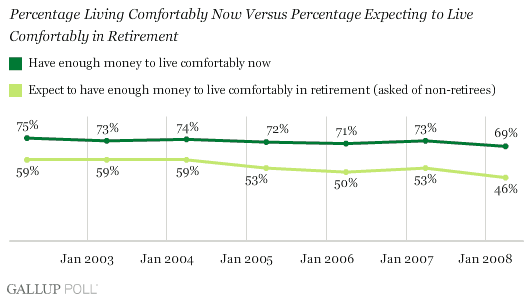
Sixty-nine percent of Americans say they are living comfortably right now — down four percentage points from last year and six points from 2002. However, the percentage of those yet to retire who think they’ll be able to live comfortably in retirement fell even more precipitously, dropping to only 46% from 53% a year ago and 59% in 2002.


Many Worried About Having Enough Money for Retirement

When asked about their financial worries in Gallup’s April 6-9 Economy and Personal Finance poll, 63% of Americans say they are worried they will not have enough money for retirement — exceeding the 56% who are worried about not being able to pay the medical costs associated with a serious illness or accident and the 55% who are afraid they will not be able to maintain the standard of living they now enjoy. Even as Americans are bombarded by a wide range of immediate-term economic concerns ranging from surging gas, food, and healthcare costs to a decline in jobs and a debacle in housing, their most prevalent fear seems to be centered on not being able to achieve a comfortable retirement.
In part, this may be an often-unnoticed result of today’s economic turmoil. Not surprisingly given the soaring cost of everyday essentials, the percentage of Americans saying they have enough money to live comfortably right now is 69%, down from the 75% of 2002 as well as the 73% of last year. With incomes stagnating and prices surging, fewer Americans have enough income to live comfortably.
In this context, it seems reasonable for fewer Americans to feel confident they will have enough money to live comfortably in retirement, when their incomes are not only generally lower but also relatively fixed. Add in today’s comparatively low interest rates, and one might argue that many of the 46% of Americans who think they’ll be able to live comfortably in retirement are being somewhat optimistic. Of course, this does represent a 13-point drop from the percentage of Americans holding this view in April 2002 and a seven-point decline from just last year. Note also that the gap between the percentage of Americans feeling they have enough money to live comfortably now compared to those having similar expectations for when they retire has increased from 16 points in 2002 to 23 points today.

Economy Affecting Retirement Income Expectations
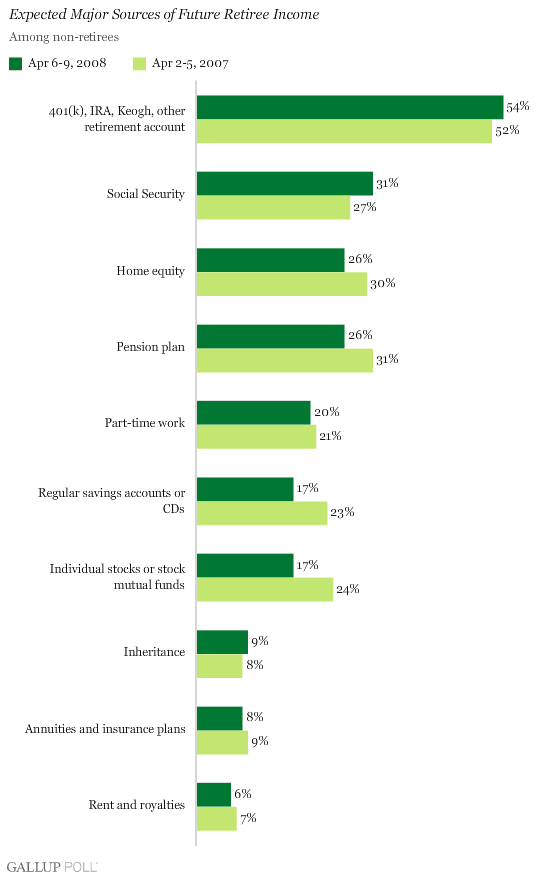
Fifty-four percent of those who have yet to retire say they expect their 401(k), IRA, Keogh, or other retirement savings accounts to be a major source of income for them in retirement. This is up two points over the past year, despite the losses some people have experienced in their tax-favored accounts during the recent past. Social Security is mentioned second most frequently, with 31% seeing it as an expected major source of retirement income — up from 27% a year ago — and not necessarily good news given the current condition of the Social Security system.
One reason more future retirees fear they will not be able to live comfortably in retirement may have to do with the impact of recent economic trends on their financial well-being. For example, only 17% of future retirees expect individual stocks or mutual funds to be a major source of their retirement income, down by nearly one-third from the 24% who thought these investments would be a major source for them a year ago. There has been a similar six-point drop, from 23% to 17%, in the percentage expecting their regular savings accounts or CDs to fill this role. At the same time, the percentage of those looking to a work-sponsored pension plan as a major source of retirement income has fallen five points, from 31% last year to 26% this year, while those looking to the equity in their homes is down four points, and is now also at 26%.

Commentary
Today’s economic stagflation has one in four Americans “very worried” that they will not be able to maintain the living standard they now enjoy. But with many baby boomers approaching retirement age, the full impact of today’s economic woes may not be fully realized for several years.
For example, the home has traditionally been the average American’s primary source of wealth. However, the current residential real estate debacle now threatens the value of that asset for many. Not only are many Americans experiencing foreclosure, but their neighbors are seeing their housing values plunge as potential purchasers hesitate to buy and as foreclosed properties drive down the value of nearby properties.
At the same time that their real estate values are declining, Americans see the interest rates on their savings deposits at low levels while the risks in the equity markets seem high. And while one in five Americans who have not yet retired now say they expect a part-time job to be a major source of their retirement income — double the level of 2001 — this number could grow as an increasing number of baby boomers find that today’s economy will make it hard to retire comfortably.

Please visit our site for more Retirement, 401k, and Insurance details:
www.erollover.com


Featured Sponsor:


Subscribe in a reader

Add to Technorati Favorites


MyFax.com - Faxing Simplified

Subscribe to erollover.com Blog by Email

vote nowBuzz up!

Tuesday, September 2, 2008

How to save $$$ when Buying Life Insurance

www.erollover.com

Subscribe in a reader

Subscribe to erollover.com Blog by Email

How to save $$$ when Buying Life Insurance

By Mike Rowan for www.Erollover.com 2008

Ways To Save When Buying Life Insurance
When it comes to shopping, savvy shoppers get the most for their money. This stays true not only when shopping for groceries or food, but for life insurance as well. So to help you get the most bang for your buck, eRollover.com has compiled a list of ways you can save the most when you’re in the market to buy a life insurance policy.

1. Is term life insurance for you? If most of your goals are short-term and you’re not as interested in saving for the long run, term life insurance is for you. Term life insurance typically offers you the most coverage for the least amount of money, and is set up based around spans of time. For example, you may get a term life insurance plan that is set to pay out after five, ten or 20 years.

If your main goal is to save money, and you don’t mind paying a higher premium, it would be wise to look into a whole life insurance policy. Whole life policies offer a “cash value” feature that helps you save money each time you make a payment on your premium. However, though you can withdraw funds from the cash value, your death benefit will decrease. If you take out a loan and it exceeds the amount you have already paid for on the premium of your whole life insurance policy, you will receive a tax bill. Also, it’s good to note that as time moves on, the cost of insuring you will go up, and your cash value will begin to decrease.

2. If you’re healthy, stay away from guaranteed issue policies. Guaranteed issue policies, also know as “simplified” or “quick” policies, may sound too good to be true, because they really are. They do not require a medical exam, making them seemingly ideal, but ultimately much riskier for the insurer. If you are healthy, you will get much better rates by buying a life insurance policy that requires a medical test.

However, the problem for those who buy into guaranteed issue policies is that many may end up paying more in premiums than their beneficiaries receive from their death benefits. The National Association of Insurance Commissioner (NAIC) is trying to find a solution or way to put an end to this. Regulation of rates is not something they plan on doing, but a disclosure statement warning consumers is in the works.

3. Check online. When shopping around for any kind of insurance, looking online is a great way to compare prices and see what different companies have to offer. The more information you give, the more accurate your insurance quote will be. Quotes and comparisons can be run at www.erollover.com/life

4. Make a change for the better. If you are overweight, are a smoker, have heart disease, high blood pressure or diabetes, finding affordable life insurance may be difficult. This is because the better your health is, the easier and more affordable it will be for you to buy life insurance. Insurance companies will issue lower premiums if the policyholder is in good health standing. The less things that may give you a risk of dying sooner, the more affordable your life insurance policy will be. Also, if you do have an outstanding medical condition, you are a smoker or overweight, and you are trying to better your health, be sure to document it. By showing the insurance company your medical files and that you have been trying to improve your health, you may save yourself some money in the long run.

Many life insurance companies have different categories for medical conditions or combinations of medical conditions, when it comes to issuing you a policy. They also have different tests and medical exams you may need to go through before they will issue you a policy. This may have a major impact if you’re a smoker. Even if you quit the day you apply, you will still be considered a smoker, because to be completely “nicotine free,” you would have had to quit smoking for two to five years prior. Smokers do generally pay at least three times more than nonsmokers for a life insurance policy, so by quitting, you’re not just saving money from not buying tobacco, but also by bettering your standing.

Being overweight is another reason you may have a higher life insurance premium. Though you may not be obese, once your weigh reaches a certain level, you become more of a death-risk. So by taking the steps to lose weight and get healthier, you are not only helping yourself live longer and feel better, but also helping to get more affordable life insurance rates.

5. Buy what you need. It’s not a good idea to under-buy insurance, nor is it beneficial to over-buy, so when you’re in the market for insurance, be sure to evaluate what your exact needs are and go from there. A good way of doing that is in the form of an equation: Short-term needs + long-term needs - resources = how much life insurance you will need.

6. Buy early. Instead of waiting until there is a real problem with your health, buy life insurance early in life. As you age, the price of your life insurance will increase, so the younger you start, the more you will save. To keep your premium low, you may want to inquire about a “level premium” policy. Which keeps your premium rates the same for a set amount of time.

7. Fractional premiums. Some insurance agencies charge less depending on how you schedule your payments. By paying fractional payments-those are fewer payments over the year-you may pay less over all. For some life insurance companies the same also goes for electronic funds transfer (EFT), which is when they take out the amount of the premium directly from your checking account.

8. Being responsible saves you money. This goes along with making a change for the better. If you are in an expensive rate class due to high cholesterol (for example), but make a point of going to your doctor regularly and establish a history of lowering your cholesterol, your life insurance company may be willing to lower your premium.

If you are interested in finding out more about life insurance, or getting a life insurance quote, log on eRollover.com/lifeinsurance. Here you will be able to evaluate multiple rates from best-in-class life insurance providers - helping you find the best life insurance coverage that benefits you, as well as your beneficiaries, while still being within your budget. We can be reached at 888-243-9990 or at mike@erollover.com for further information about applying.

Please visit our site for more Retirement, 401k, and Insurance details:
www.erollover.com


Featured Sponsor:


Subscribe in a reader

Social Bookmarking

Add to Technorati Favorites


MyFax.com - Faxing Simplified

Subscribe to erollover.com Blog by Email

Monday, September 1, 2008

I started contributing to my 401k-Now What?

Subscribe to erollover.com Blog by Email

I started contributing to my 401k-Now What?

By Mike Rowan for www.Erollover.com 2008

“My company matches 50 cents for every dollar I put into my 401(k). I just started this year and have a balance of about $1,200. I know nothing about investing, however. So what should I invest in to increase my account balance?” –Real Client

First, let me congratulate you for taking the single most important step in planning for your retirement: signing up for your 401(k) plan. Unfortunately, many people don’t see their 401k or IRA plans as an urgent priority, choosing instead to live for the moment.
That’s especially true among young workers. A recent survey by Hewitt Associates found that almost 70 percent of Generation Y workers (those 18 to 25 years old) don’t bother to contribute. Retirement for these individuals is 30 or 40 years away, which is extremely hard to fathom in some cases. Many times this potential retirement money is spent on depreciating assets, like nice cars and the like.

Whatever the reason, missing out on the chance to save through a 401(k) is a big mistake, especially when your employer is kicking in matching bucks. I mean, it’s not often you have someone giving you free money.

So now that you’ve taken that big first step, how do you tend to maximize the benefits of your 401k or retirement plan? Understandably, you’ve probably immediately turned your attention to investing. After all, the higher the return you earn on your contributions (and your employer’s match), the larger your nest egg will be come retirement time.

Contribute first, invest later

But as important as smart investing is in building your 401(k)’s balance over the long term, before you turn your attention to that front there’s something else you want to be sure you’re doing-namely, contributing as much as you possibly can.
That’s right, although we tend to concentrate our efforts to the investing side of the equation, the fact is when it comes to surefire ways of boosting your balance, shoveling in more money has a much bigger (and more certain) effect than savvy investing.

A study done by Putnam Investments last year illustrated this point very well. Basically, Putnam created a hypothetical “Average Joe,” who began participating in his 401(k) at age 28 in 1990, but got off on the wrong foot. He contributed very little, invested too little of his account in stock funds and he also chose funds that didn’t perform very well. The study then compared how Joe would have fared over the next 25 years had he made certain moves, namely: boosting the percentage of pay that he saved, increasing his exposure to stocks and choosing better-performing funds.

The study found that while Joe certainly would have boosted his 401(k) balance by picking better funds and tilting his portfolio mix more toward stocks, the gains from those two moves didn’t come close to the increase Joe would see if he dramatically boosted the amount he saved-even if he remained invested in underperforming funds.
The moral: if you really want to increase your 401(k)’s balance, you should first make sure you’re contributing as much as you possibly can to your account. At the very least, you want to contribute enough to take full advantage of your employer’s match. But beyond that you ought to try to contribute as much as your plan allows.

Picking the right mix
Once you’re saving to the max, you can then concentrate on the investing part. Here your first priority is to make sure you’re divvying up your portfolio properly between stocks and bonds.
A variety of studies show that your asset allocation - the mix between stock and bonds - is what largely determines the performance of your investment portfolio. The more you have in stocks, the higher your returns are likely to be over the long term.
So why not throw the whole shebang in stock funds? Well, for one thing you can never be absolutely sure that future performance will repeat the past, so it pays to hedge your bets. And besides, the more stocks you own in your 401(k), the bigger the hit your account will take during market downturns. If you devote too much to stocks, a big loss might frighten you out of stocks completely, undermining your long-term strategy.
To arrive at a mix that’s appropriate for you, you can check out our Asset Allocator.

As for specific investments in your 401(k), you’re limited to the menu of funds that your employer provides. (This is also a great reason to always roll your 401k into a self directed IRA if you were ever to switch jobs.) Ideally, you want to choose funds that have low costs, decent track records and a history of treating shareholders decently. Index funds are also almost always a good bet. Their costs are typically low and since they’re designed to mirror a particular market index or benchmark, you know exactly what you’re getting.

We have outlined some basic steps and strategies for your 401k, IRA, or retirement plan. While no course of action is absolutely bullet-proof, at least making an aggressive effort to contribute early and often should set you in the most advantageous path.

Please visit our site for more retirement and 401k details:
www.erollover.com


Featured Sponsor:


Subscribe in a reader

Add to Technorati Favorites


MyFax.com - Faxing Simplified

Subscribe to erollover.com Blog by Email

Kontera Tag

eRollover.com Blog